




Instruments to accelerate environmental offsets and other financial mechanisms for biodiversity conservation.
11/04/2024
High Impact Conservation Agreements.
13/06/2024Instruments to accelerate environmental offsets and other financial mechanisms for biodiversity conservation.
11/04/2024High Impact Conservation Agreements.
13/06/2024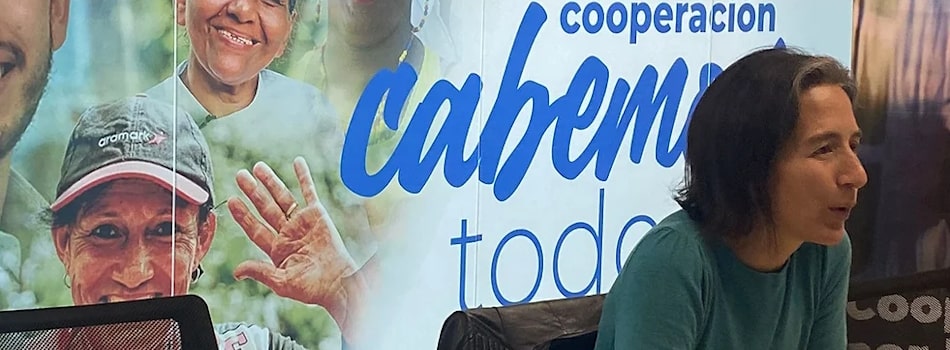
The Presidential Agency for International Cooperation and Terrasos developed the Webinar: Habitat banks, biodiversity credits and their contribution to Target 19.
Bogotá, June 6, 2024
The Presidential Agency for International Cooperation (APC Colombia) and Terrasos have collaborated to create a webinar, hosted on a social platform, featuring Mariana Sarmiento, CEO of Terrasos. In this meeting, the trajectory of Terrasos in Colombia over the past 10 years was presented. The company's B Corporation certification, which demonstrates a commitment to continuous improvement and a socio-environmental business purpose at the core of its operations, was highlighted. Its work on biodiversity in the country, and its commitment to addressing a need and facilitating private investments in biodiversity in our territory, ensuring high impact and long-term sustainability, with a focus on rural development in our territories.
Furthermore, it was observed that Terrasos has impacted over 50,000 hectares in Colombia through its involvement in this development process, collaborating with private enterprises and international cooperation organizations. Terrasos has distinguished itself as a pioneer in the implementation of Habitat Banks in Colombia and Latin America, as evidenced by the following figures: In addition, Terrasos has been involved in over 31,000 hectares of mandatory compensation projects, 5,490 hectares of Habitat Banks, 1,467 hectares of restoration schemes, 4,097 hectares of preserved areas, five threatened ecosystems in conservation projects, and has mobilized over seven million dollars in private resources for biodiversity conservation in specific territories.
The company has been working in some of Colombia's most vulnerable ecosystems, which support a significant portion of the country's population, to enable adaptation to climate change and reduce vulnerability to its effects.
Mariana Sarmiento stated that her work in Colombia has gained international attention, positioning the country as a global leader in innovative biodiversity financing strategies for developing nations.
Biodiversity Credits
Regarding biodiversity credits, the objective of this bet is to find instruments that mobilize resources and facilitate their investment between the private and public sectors, a process aligned with 'Target 19' and is where the conversations at COP16 will be focused, as financial resources and national and international, public and private sources of biodiversity are increased.
Hence, biodiversity credits make sense within the principle of payment by results, consisting of an anticipated investment that is reflected in an opportunity to accelerate resources in conservation and thus bring in investors, insuring and eliminating risk factors.
In Colombia, there are at least 76,607 hectares of environmental offsets to be executed by 2024. However, there are several disadvantages, including short-lived and scattered initiatives with no focus on results, as well as the waste of money and delays in implementing environmental offsets. These challenges present an opportunity to adjust commitments and catch up.
The financial implications of achieving the biodiversity goals are significant. Estimates suggest that the funding requirements for implementing Colombia's Biodiversity Action Plan amount to 0.93 billion dollars (Moncaleano et al., 2022). However, there is an opportunity to bridge this gap by developing effective awareness-raising strategies that highlight our collective dependence on biodiversity.
Terrasos has today sold 4,000 biodiversity credits, a solution offered by the Habitat Banks for the generation of these credits. The offer process for the first 10 years is within a 30-year project term.
The webinar with APC Colombia concluded with a discussion of Habitat Banks, which are conservation areas managed under a payment-by-results scheme. In these areas, preservation and restoration actions are carried out under technical, legal, and financial guarantees in threatened ecosystems. Terrasos currently has 12 Habitat Banks, each of which includes the following: land management, plan formulation, baseline survey, incentive to the owner, implementation of activities, 30-year monitoring, follow-up, administration of the autonomous patrimony, usufruct administration, sustainability fund, external auditor, and contractual administration.