


Protocol for the Issuance of Terrasos Voluntary Biodiversity Units
What is it and what’s its purpose?
The Protocol defines how Terrasos Biodiversity Units – Tebu – are generated. These are a type of biodiversity credit that represent 10 m² of preserved or restored ecosystems, maintained under technical, financial, and legal conditions that ensure their long-term permanence.
These units are applicable across various results-based payment schemes and use cases: from meeting regulatory or contractual requirements, to strengthening supply chains, enhancing sustainability reporting, differentiating products, supporting public programs, or channeling philanthropy toward real impact. Each conservation investment is designed to deliver verifiable and lasting benefits for biodiversity and local communities.
This document:
• Defines the Voluntary Biodiversity Units (Tebu)
• Establishes the requirements and principles for project registration and Tebu issuance.
• Describes how to quantify the generated Tebus.
• Outlines the monitoring, reporting, and verification process.
• Proposes a milestone-based unit release scheme.
• Sets criteria for registry platforms to prevent double counting .
• Defines roles within the certification and issuance chain.
Why Tebu?
Tebu offers landowners and project developers a clear and reliable tool to finance conservation.
-
Scientific and Legal Integrity: Each unit follows a validated protocol, with digital traceability and independent verification
-
Flexible Application: Suitable for projects involving various terrestrial ecosystems, sizes, and durations.
- Market Confidence: Backed by real-world cases involving companies, governments, and investors already using Tebu in Colombia and across Latin America
By using this Protocol, your project gains credibility with investors and buyers, and opens the door to results-based payment schemes that secure long-term resources for preserving and restoring your land.
Downloads
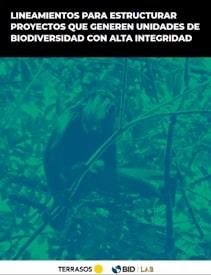
Principles of Integrity
The Tebu Protocol is grounded in a set of principles that ensure the technical, legal, and financial integrity of each Biodiversity Unit. These principles guarantee that conservation projects are transparent, traceable, and sustainable over the long term.
Each project must ensure compliance with the following principles:
Who Can Apply the Tebu Protocol?
In addition to meeting the integrity principles, projects with the following characteristics may apply the Protocol and generate Tebu:
- Minimum duration of 20 years.
- Terrestrial ecosystems.
- Preservation and/or restoration actions.
- Legal and territorial feasibility.
Terrasos supports project developers in implementing the Tebu Protocol through Collaboration Agreements.

How Does It Work?
The issuance process for Biodiversity Units begins with landowners or communities who dedicate their land to conservation. A project developer then designs, registers, and coordinates the implementation. An independent verifier validates ecological progress, and if milestones are met, authorizes the issuance of units. These units are registered on official platforms and can be acquired by clients through sales channels.
Roles in the Value Chain
This framework shows how different actors collaborate to generate high-integrity conservation projects that issue Tebu:


Landowner or Community
• Owns the land and signs agreements to restrict land use for conservation.
• Works to meet performance standards.

Project Developer and/or Operator
• Structures the project’s Registration Document.
• Implements the operations and maintenance plan.
• Markets the Voluntary Biodiversity Units.

Independent Validator and Verifier
• Validates ecological milestones.
• Verifies performance milestones.

Registry Platforms
• Ensure traceability, prevent double counting, and record issued, retired, and available units.

Sales Channels
• Connect projects with buyers.
• Report the number of units sold to the registry platform.

Clients
• Acquire Tebu to fulfill various objectives.
Ecological and Management Milestones
The Tebu Protocol operates under a results-based payment scheme. Biodiversity Units are not released all at once but gradually, as ecological and management milestones are met and validated by an independent verifier.
• Management Milestones: Administrative or implementation achievements that ensure project sustainability, such as land acquisition, land-use restrictions, fence installation, or planting initiation.
• Ecological Milestones: Progress in ecosystem recovery, such as replacing degraded cover with native vegetation, restoring forest connectivity, improving wildlife habitats, increasing species diversity, or enhancing soil quality.
How Is the Quantity of Tebu Defined?
The Terrasos Protocol outlines five key factors that determine how many Biodiversity Units (Tebu) a project can issue over its lifetime. These factors aim to reflect the true impact of preservation and restoration efforts:

Threat Category of the Ecosystem
Measures the level of threat in the ecosystem where the project is implemented.

Connectivity Opportunity
Assesses the project’s ability to improve ecosystem connectivity and facilitate species movement.

Community Engagement
Evaluates the involvement of local or ethnic communities in project management.

Project Duration (Years of Operation)
Considers the length of the project’s operational period.

Actions (Restoration and Preservation)
Differentiates between conserving well-preserved ecosystems and restoring degraded areas
Explore how to calculate Tebu for your project
Explore Our Projects Using the Protocol
By purchasing Tebu, you contribute directly to the protection of vital ecosystems.