




The challenge of COP16 is the implementation of financial mechanisms for biodiversity.
12/03/2024
The Presidential Agency for International Cooperation and Terrasos developed the Webinar: Habitat banks, biodiversity credits and their contribution to Target 19.
06/06/2024The challenge of COP16 is the implementation of financial mechanisms for biodiversity.
12/03/2024The Presidential Agency for International Cooperation and Terrasos developed the Webinar: Habitat banks, biodiversity credits and their contribution to Target 19.
06/06/2024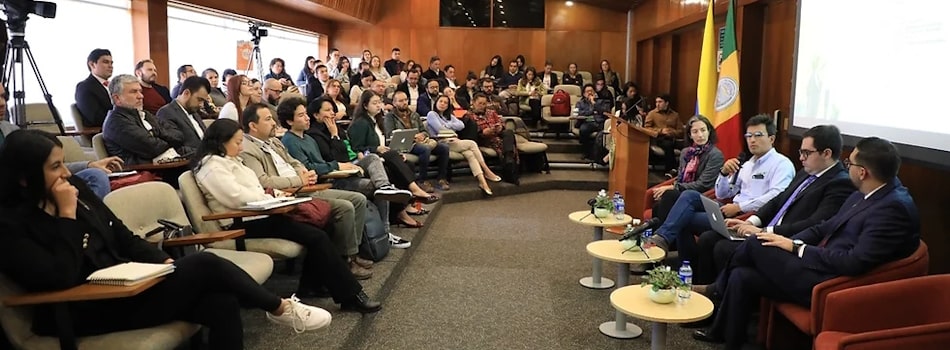
Instruments to accelerate environmental offsets and other financial mechanisms for biodiversity conservation.
- Habitat Banks were recognized as a forced investment compensation mechanism of not less than 1%, regulated by Resolution 1051 of 2017 and adopted by Resolution 256 of 2018 as a compensation mechanism.
- The forum addressed compensation mechanisms such as Conservation Agreements, Habitat Banks, Payment for Environmental Services and Land Purchase and their challenges to ensure the long-term sustainability of these interventions.
- The meeting shared challenges and success stories on environmental offsets and instruments to accelerate them, from companies and academia such as: Ocensa, Terrasos, ISA Intercolombia, Fundación Natura, Consga and Universidad Externado.
Bogotá, April 11, 2024
Environmental offsets are a fundamental instrument to ensure that the residual impacts caused by development projects that can be remedied through the implementation of actions of restoration, enrichment or preservation of biodiversity equivalent to those affected. For this reason, the Environmental Law Department of the Universidad Externado de Colombia and Terrasos developed the event 'Instruments to accelerate environmental offsets and other financial mechanisms for the conservation of Biodiversity'.
The forum was attended by the government through the Ministry of Environment and Sustainable Development, the ANLA and private sector companies and began with the participation of the director of the Department of Environmental Law of the Universidad Externado de Colombia, Carolina Montes Cortés, who pointed out that since 1972 countries have been expressing their concern for environmental issues in the international context, with Sweden, the United States and Norway having a legal framework on the subject. Cortés pointed out that, “currently, the number of countries with environmental laws is much greater. However, today there are doubts about the state's capacity to enforce these regulations.
Jenny Gallo, Technical Advisor of the Directorate of Forests, Biodiversity and Ecosystem Services of the Colombian Ministry of Environment and Sustainable Development, highlighted three challenges in this area: a. how to conserve nature, b. how to recover it, and c. land use planning around water. Among the tasks that the Government is advancing, Gallo indicated that the revision of the compensation manual is under development, they plan to have it ready in a few months and to make adjustments to the resolution of the Habitat Banks. Offsets must also include greater innovation for implementation with other proposals that are within the voluntary market and that are beginning to take hold, such as biodiversity bonds or units.
In this regard, the government added that, “we must also take advantage of the fact that we are the host country of the COP16, this is the most important event to be held in decades in environmental terms in Colombia and this has allowed the mobilization of resources and will be a key scenario for the issue of environmental compensation to be framed at a global level,” added the advisor to the Ministry of Environment.
Compensation Tools
During this panel, the lessons learned and challenges of the different compensation mechanisms were presented, including habitat banks, payments for environmental services (PES), conservation and usufruct agreements and land purchase.
This first block of the event, called 'Trends in the execution of the strategy for the dynamization of compensations, was attended by Luis Enrique Orduz, deputy director of instruments, permits and environmental procedures of the ANLA; Mariana Sarmiento, general manager of Terrasos, and Antonio Dasco, technical manager of CONSGA.
Orduz stated that environmental compensation should compensate and reimburse communities and ecosystems for impacts that could not be mitigated. In this sense, the compensations must guarantee the biological corridors and the direct relation with the deforestation reduction goals.
“We found that the greatest number of compensation gaps are in the territorial execution, the implementation of compensation plans and in the territorial governance needed to be able to successfully carry out the compensation plans. According to the diagnosis carried out, the greatest challenges in the implementation of these issues are associated with the identification of equivalent ecosystem areas within the same hydrographic subzone,” said the ANLA spokesperson.
In addition, Orduz also commented that “it is necessary an iron will of the holders, to be able to implement and execute the compensations, I do not underestimate the difficulties, as it was said there are 100,000 hectares, which at the end of the day is money and costs for the holder of the environmental license and we would like to see greater intention and greater willingness on the part of the holders to execute the compensation plans”.
Regarding the Habitat Banks, Mariana Sarmiento, general manager of Terrasos, explained that they operate under a payment by results scheme that ensures compliance with ecological milestones, compliance with the environmental authority, and a 30-year conservation guarantee. “One of the great challenges in the country is land tenure. We find ourselves with a lack of land ownership and if in one environment it was difficult to make 15-year conservation agreements, the issue was more complex at 30 years, but they allow us to add requirements and generate economies of scale by ensuring agreements that give guarantees to the private sector, the communities and the State, said Sarmiento.
Among the great results that Terrasos has achieved with its environmental compensation programs are the generation of trust in the territories, making the execution advance at a good pace. On the other hand, the Habitat Banks offer the possibility of a voluntary market in credits or Biodiversity units, not necessarily for companies that want to compensate, but for companies that want to go beyond, this with the purpose that each person can make strong contributions to spaces of 10 m² for 30 years.
Antonio Dasco, CONSGA's technical manager, referred to payments for environmental services, which are another compensation instrument. As he explained, these instruments make compensation more dynamic by representing a strategic way of conservation in highly important environmental areas and the involvement of the communities. “Something key is that if the communities are not involved, it will not be possible to maintain these projects over time, since the challenge is what will happen to the recovered ecosystem when the payments expire,” he said.
Success Stories
The second block of the panel included the participation of companies that have led successful cases in the implementation of instruments to accelerate compensation, such as ISA, Ocensa and Fundación Natura. Among the cases referred to are carbon credits and biotic offsets.
Camilo Domínguez Gutiérrez, Director of Integral Responsibility Oleoducto Central S.A. OCENSA, shared the company's experience in its four years making 1% investments in Habitat Banks, emphasized that it is necessary to implement more in the Colombian territory and also commented that “for Ocensa, the Meta Habitat Bank is a success story, mainly because of the way it allows us to manage the main risks we face in the management of compensation”.
Obed Andrés Moncada Rojas, biotic compensation coordinator of ISA Intercolombia, spoke about the actions that are being carried out within its compensation portfolio and pointed out that, “through biotic compensation we carry out actions to compensate and reimburse ecosystems and communities for the impacts caused on biodiversity. This mechanism not only seeks to compensate the impacts caused by our activities, but also to contribute to the country's biodiversity through effective and efficient compensation actions over time”.
Francisco Torres, head of the ecological restoration plan for the El Quimbo hydroelectric plant at Fundación Natura, shared his experience in the ecological restoration process in the tropical dry forest of the El Quimbo hydroelectric plant and emphasized that “one of our main interests is that the compensation is fulfilled and the company complies with its obligation. But we are also interested in ensuring that the area is maintained in the long term and that it is integrated into regional planning as a protected area, and that it is recognized by more authorities.
Regarding the guarantee of transparency in compensation projects, Eduardo Del Valle Mora, professor and researcher at the Universidad Externado de Colombia, mentions that the solution must be technological. “We have the Colombian Environmental Information System (SIAC), which does not work. One should be able to enter the SIAC and find which compensations have been approved, which companies are in charge of them, whether sessions were held or not, and the traceability of the resources. In the SIAC it should be possible to review and organize the territory. This should be a technological instrument of information that feeds on data from other entities. The day this works, we are 50% of the solution because the structuring will not have many surprises”, considered Del Valle Mora.
Finally, Luis Felipe Guzmán, research professor at the Universidad Externado de Colombia, recapitulated that offsets must be related to innovation and require the search for new tools that allow them to be effective and provide opportunities for improvement. Likewise, one of the main conclusions of this meeting is that a regulatory improvement is needed to ensure institutional governance in environmental compensation issues for Habitat Banks.
He also commented that compensation should guarantee biological corridors and a direct relationship with deforestation reduction goals and should generate social commitments with the communities. He added that property insurance is necessary to be able to move forward with compensation actions.
This Academic Forum sought to bring companies to learn first-hand about experiences, actions and solutions on environmental compensation and instruments to accelerate them, which mitigate the impact on biodiversity in our country with economic projections in extractive and infrastructure activities, where it is of vital importance to ensure the least loss to ecosystems.