



CAR Establishes New Rules to Compensate Environmental Impacts in Cundinamarca
21/08/2025
Banco de Occidente and Terrasos promote investment in biodiversity through the use of credit cards
10/02/2026CAR Establishes New Rules to Compensate Environmental Impacts in Cundinamarca
21/08/2025Banco de Occidente and Terrasos promote investment in biodiversity through the use of credit cards
10/02/2026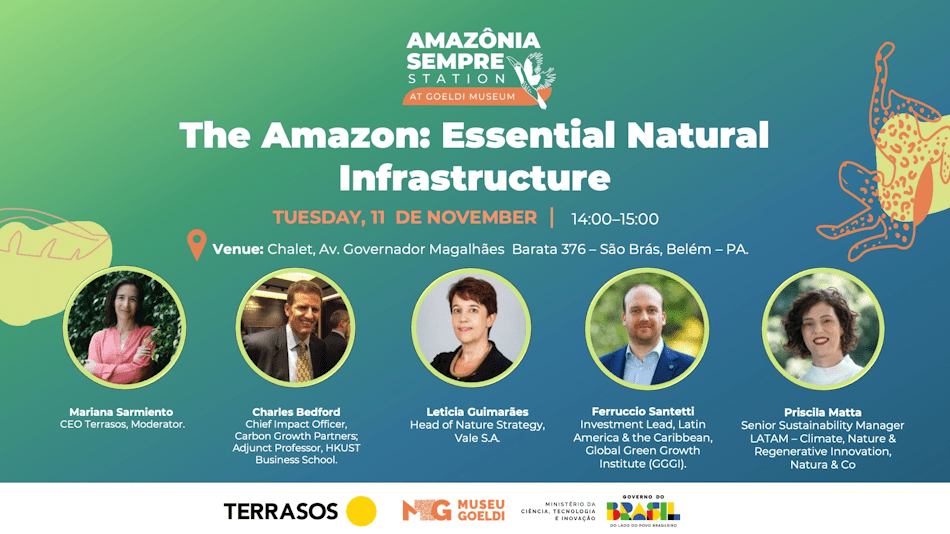
The Amazon as Essential Natural Infrastructure: High-Level Event in Belém Proposes New Financing Models
• The event proposes a paradigm shift by treating the Amazon as essential natural infrastructure and financing it with the same rigor as roads or ports.
• Experts from Terrasos, GGGI, Natura & Co, and Vale will discuss how biodiversity units and other tools can channel private investment into the conservation of the biome.
• The dialogue aims to reposition nature as a critical asset for the economy and risk management, aligning with global biodiversity financing goals.
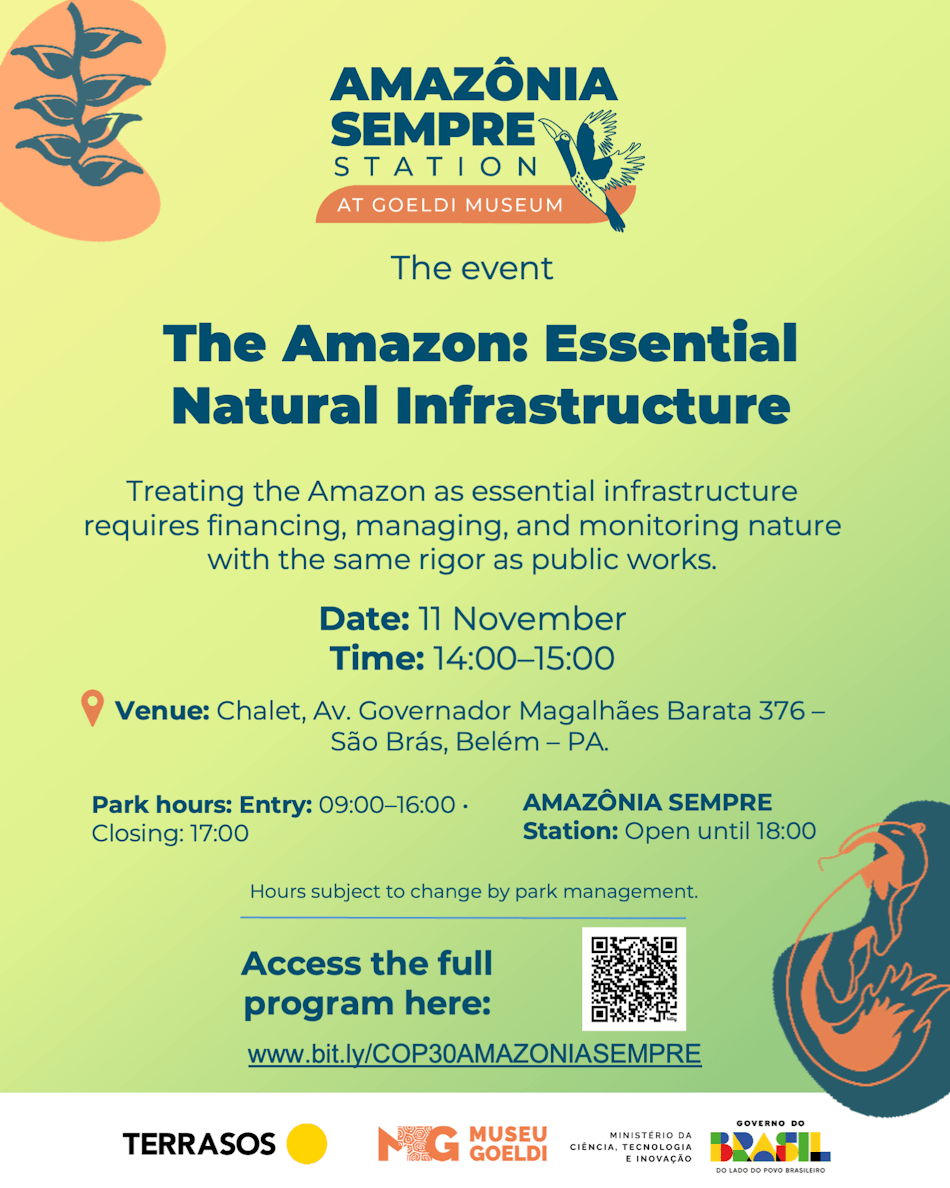
• The event will take place on November 11, 2025, at the Museu Goeldi in Belém, laying the foundation for collaborations leading up to COP30.
Belém, Brazil, November 7, 2025 – On the path to COP30, key players from the public and private sectors, multilateral organizations, and academia will gather in Belém for an urgent dialogue on how to treat the Amazon not as a liability but as a critical infrastructure asset that requires investment and maintenance, just like roads or power plants.
The event, "The Amazon as Essential Natural Infrastructure," organized by Terrasos, will take place on November 11, 2025, from 2:00 to 3:00 PM, at Estação AMAZÔNIA SEMPRE – Chalet, Museu Goeldi (Av. Governador Magalhães Barata, 376 – São Braz, Belém – PA).
The degradation of the Amazon poses a direct threat to regional economic stability, food security, and global climate resilience. This biome regulates rainfall, stores carbon, generates energy, and supports millions of people. However, unlike "gray" infrastructure (ports, roads), nature lacks dedicated investment flows and structured financing models.
“We propose a paradigm shift: to finance, manage, and maintain the Amazon with the same rigor applied to built infrastructure,” says Mariana Sarmiento, CEO of Terrasos and moderator of the panel. She adds, “Mechanisms like biodiversity credits and habitat banks are key tools to channel both private and public capital into the restoration and conservation of this essential asset.”
Objective and Core Topics
The event aims to foster a high-level dialogue on how financial mechanisms—such as biodiversity credits, results-based investments, and public-private partnerships—can sustain the biome’s ecological infrastructure.
Topics for discussion will include:
-
The Amazon as Infrastructure: Understanding its critical role in providing ecosystem services.
-
Financing Ecological Infrastructure: Exploring investment frameworks from institutions like the Global Green Growth Institute (GGGI).
-
Corporate Dependence on Nature: How companies like Natura & Co and Vale integrate biodiversity into their strategies and supply chains.
-
Results-Based Financing: How biocredits can mobilize capital through measurable and verifiable ecological outcomes.
International Panelists
The panel will feature prominent experts:
-
Mariana Sarmiento (Moderator), Founder & CEO, Terrasos
-
Charles Bedford, Chief Impact Officer, Carbon Growth Partners; Adjunct Professor, HKUST Business School
-
Leticia Guimarães, Head of Nature Strategy, Vale S.A.
-
Ferruccio Santetti, Investment Lead, Latin America & the Caribbean, Global Green Growth Institute (GGGI)
-
Priscila Matta, Senior Sustainability Manager LATAM – Climate, Nature & Regenerative Innovation, Natura & Co
The event is expected to help reframe nature as an essential asset for risk management and value creation. It will showcase practical models for investing in ecological infrastructure that reduce operational and financial risks. The goal is to promote multisectoral collaboration to scale biodiversity financing and identify concrete pathways to integrate ecological assets into investment, insurance, and credit frameworks.
This dialogue is a crucial step in aligning regional efforts with the Kunming-Montreal Global Biodiversity Framework (Target 19), which aims to mobilize between $600 billion and $800 billion annually by 2030.
For more information, to confirm attendance, or to request interviews with the panelists, please contact:
Mauricio Serna at [email protected] or via WhatsApp at +57 314-630-4932.