



The legacy of the Esri User Conference 2025 in Colombia’s biodiversity
26/03/2026
Terrasos expands the Mata de Lata Habitat Bank with the Villa Paula property
26/03/2026The legacy of the Esri User Conference 2025 in Colombia’s biodiversity
26/03/2026Terrasos expands the Mata de Lata Habitat Bank with the Villa Paula property
26/03/2026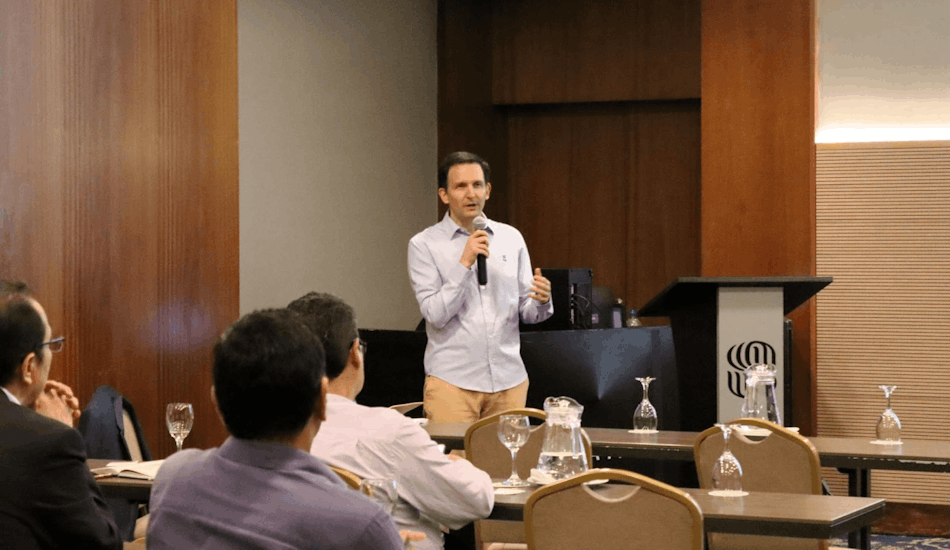
Peru advances mechanisms to attract resources for biodiversity conservation: Habitat Banks as a tool for implementing environmental offsets.
In Latin America’s dynamic economic development landscape, the critical challenge is not just growth, but how to achieve it in harmony with our natural heritage.
Recently, Terrasos has taken a strategic step in this direction by leading a series of technical workshops in Lima aimed at transforming biodiversity management in Peru, with a specific focus on the Peruvian Amazon.
These sessions, conducted in partnership with the Global Green Growth Institute (GGGI) and with support from UK PACT, are part of the project “BioFinance – Accelerating biodiversity conservation in the Peruvian Amazon.” The goal is to establish a solid conceptual foundation for implementing Habitat Banks as an innovative, inclusive, and—above all—effective financial mechanism for environmental offsets.
Why Habitat Banks in the Peruvian context?
The traditional offset model often faces limitations: fragmented interventions, short-term projects, and high execution risks that frequently end up becoming liabilities for the state. In contrast to this status quo, Habitat Banks offer a comprehensive solution:
- Aggregated Results: Instead of scattered efforts, large conservation areas are consolidated, enabling economies of scale and delivering meaningful ecological impact.
- Longevity and Sustainability: Projects are structured with long-term horizons, ensuring biodiversity management and monitoring for at least 30 years.
- Results-Based Payments: Funding is mobilized under a framework where investment is tied to the verifiable achievement of ecological milestones.
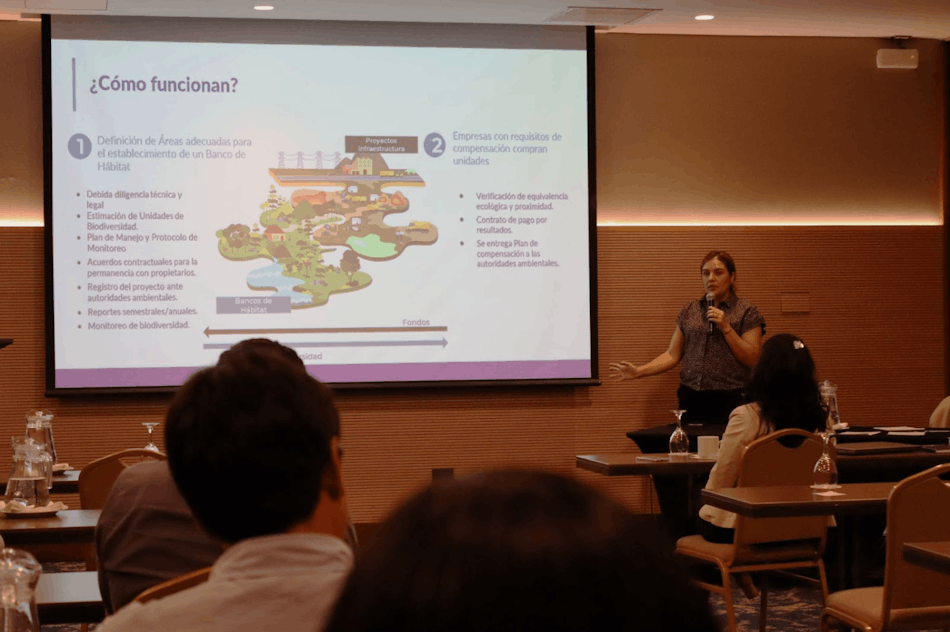
Photo: Vanessa García, Director of Strategic Partnerships.
A market with transformative potential
During the second workshop, the results of an analysis of supply and demand for environmental offsets in Peru were presented. The study revealed that, although robust regulatory frameworks such as the Mitigation Hierarchy are in place, only 30% of projects with detailed Environmental Impact Assessments (EIA-d) currently have an Environmental Offset Plan.
This gap represents a unique opportunity to strengthen the system. The underestimation of residual impacts on the biotic environment highlights the need for precise technical tools—such as the Total Ecological Value (TEV) methodology—to ensure that what is lost through development is more than compensated through effective restoration and preservation.
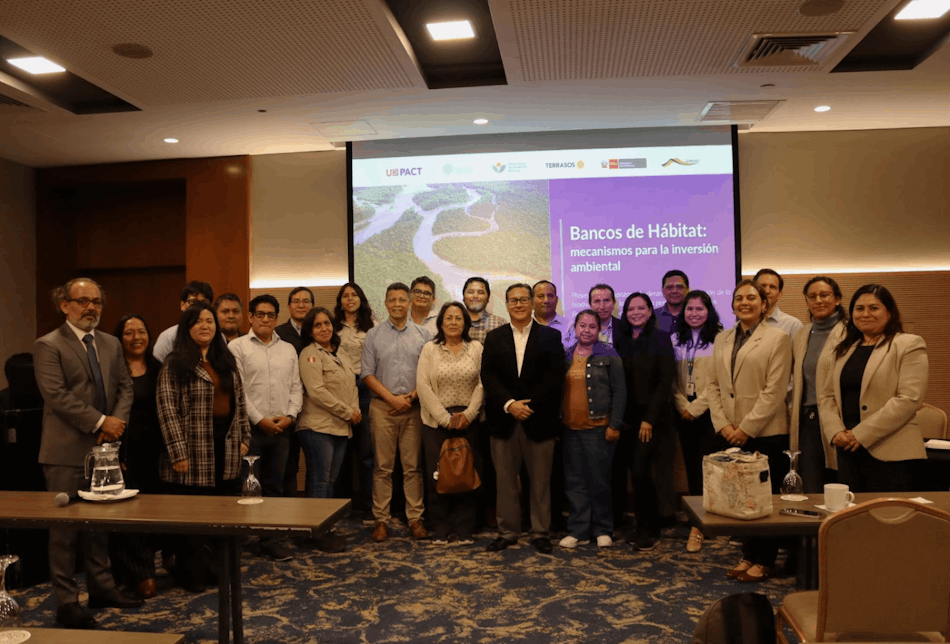
Photo: Attendees at the first workshop.
Toward the first pilot in the Amazon
The roadmap developed alongside representatives from the Ministry of the Environment (MINAM), SERNANP, and SERFOR is ambitious yet pragmatic. We are working on the design of a Habitat Bank pilot tailored to the realities of the Peruvian territory.
This process includes:
- Identifying viable areas in the Amazon with high ecological additionality
- Aligning with international standards of governance and transparency
- Strengthening technical capacities so that companies and institutions can manage their obligations with rigor
Do you represent an organization interested in strengthening its environmental impact in Peru?
We can help you design concrete, functional offset solutions aligned with the technical excellence required by the territory.
Contact us at [email protected]