



Terrasos Officially Launches the Aguadulce – Sumapaz River Habitat Bank: A Conservation Model with Measurable Impact and Blockchain Traceability
29/05/2025
A Letter from the Mountains
26/06/2025Terrasos Officially Launches the Aguadulce – Sumapaz River Habitat Bank: A Conservation Model with Measurable Impact and Blockchain Traceability
29/05/2025A Letter from the Mountains
26/06/2025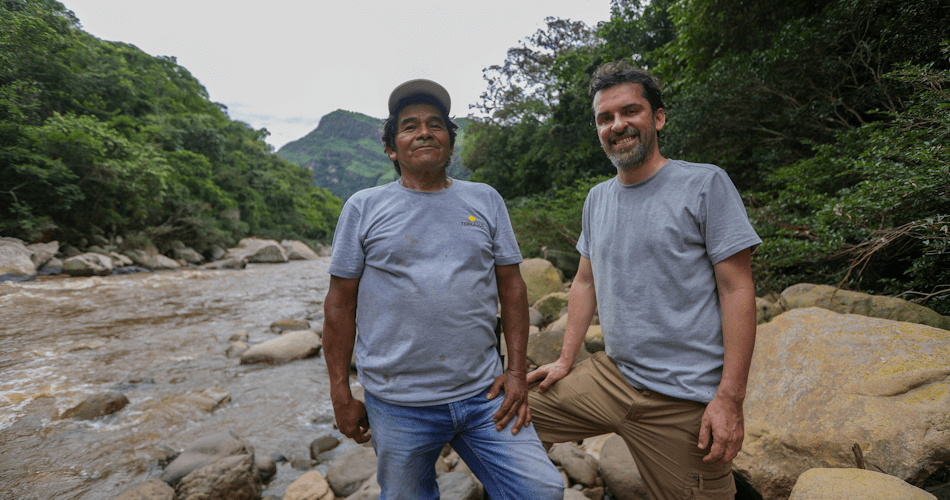
Interview in OPIS by Dow Jones: Eduardo del Valle, Manager of the Aguadulce Habitat Bank at Terrasos
This article is based on an interview conducted by journalist Humberto Rocha with Eduardo del Valle, originally published in the Biodiversity Market Report by OPIS, a Dow Jones service. Read the full report at: Biodiversity Market Report. Learn more about the author: Humberto Rocha on LinkedIn.
Eduardo del Valle has been with Terrasos, a Colombian firm specializing in environmental services, for 12 years, contributing to the creation of the first habitat banks in the country: spaces designed to channel investments into the conservation and recovery of biodiversity.
However, at one point, he wondered if there was a more direct way to protect the environment. What if he started his own biodiversity credit project?
A Story with Family Roots
Over 100 years ago, between 1920 and 1922, his wife Athenea’s great-grandparents acquired about 700 hectares of land in the Cundinamarca department, near Bogotá. A significant portion of that land was dedicated to the cultivation of coffee and cacao, two species that grow well together: coffee needs shade, while cacao thrives under trees.
Between 2018 and 2021, Del Valle and his family negotiated the repurchase of as many hectares as possible from the previous owners. “I realized that to start this biodiversity project, I had to recover the land,” said Del Valle, now a board member of Terrasos. “We didn’t inherit anything; every inch of it cost us. And that’s what gives meaning to our life project. We are custodians of this land for future generations.”
A Living Habitat Bank
The 124 hectares that Del Valle successfully repurchased became the Aguadulce Habitat Bank, with its biodiversity credit offerings managed by Terrasos. It is also the only habitat bank in Colombia with a plant and tree nursery registered with the Colombian Agricultural Institute (ICA).
The bank encompasses two distinct ecosystems: tropical dry forest and premontane wet forest. These two seemingly opposite worlds coexist and form an ecological corridor for hundreds of species, such as the ocelot and the jaguarundi—two felines with different diets but capable of coexisting in this environment.
There are two full-time forest rangers working there: Julio and Marino. Del Valle humorously notes that, due to the climatic diversity, one might say it’s raining while the other claims the opposite.
For now, Del Valle believes the 124 hectares are sufficient, as the supply of biodiversity credits still far exceeds the demand. However, he expects that to change soon as more companies understand their dependency on and impact on nature.
Restoration, Conservation, and Production
The Aguadulce Habitat Bank combines multiple approaches: areas dedicated exclusively to conservation, others to restoration, the recovery of coffee plantations, and the development of ecotourism.
Terrasos and Del Valle have relied on the experience of their two rangers—one of whom has indigenous heritage and training as a hunter—to identify and monitor the fauna in the bank, an effort that has been expanded with the use of camera traps.
“We’re working with Terrasos on a new phase to create heat maps that will allow us to track species movement within the bank and understand why they choose certain paths,” explained Del Valle.
The Aguadulce Habitat Bank is registered for 30 years, extending its operations beyond 2050. By then, Del Valle hopes the restored areas will have solidified as conservation ecosystems, that the project will have improved the quality of life for those involved, and that it will continue to be an area for organic coffee production.
Climate Change, Changing Strategy
Managing two ecosystems simultaneously and adapting to climate change has become an absorbing task. The transitions between seasons are becoming more intense and sudden.
Between March and May of this year, rainfall exceeded expectations, while the previous dry season was one of the most extreme recorded.
During the drought, temperatures inside the forest can be up to five degrees Celsius lower than in open areas, but this variability challenges planting schedules.
Last year, extreme heat dried out the seedlings, forcing Del Valle to reseed them.
Biodiversity Close to Bogotá
For Mauricio Serna, the commercial leader of voluntary investments at Terrasos, the proximity of the Aguadulce Bank to Bogotá (about 150 kilometers) is strategic. Companies based in the capital are actively interested in generating positive impacts near their operations, he told OPIS.
Terrasos has also received investments in its biodiversity credits, known as Tebu, from companies and international organizations such as the Solana Foundation, based in Switzerland.
Serna believes that if local and national companies manage to develop solid biodiversity investment portfolios, these could scale regionally and attract more foreign investors interested in Latin American projects.