



The tropical dry forest habitat bank in Cesar safeguards 825 hectares of one of Colombia’s most vulnerable and endangered ecosystems.
12/11/2021
Terrasos launches the new Habitat Bank Accelerator to promote biodiversity conservation in the country.
17/05/2022The tropical dry forest habitat bank in Cesar safeguards 825 hectares of one of Colombia’s most vulnerable and endangered ecosystems.
12/11/2021Terrasos launches the new Habitat Bank Accelerator to promote biodiversity conservation in the country.
17/05/2022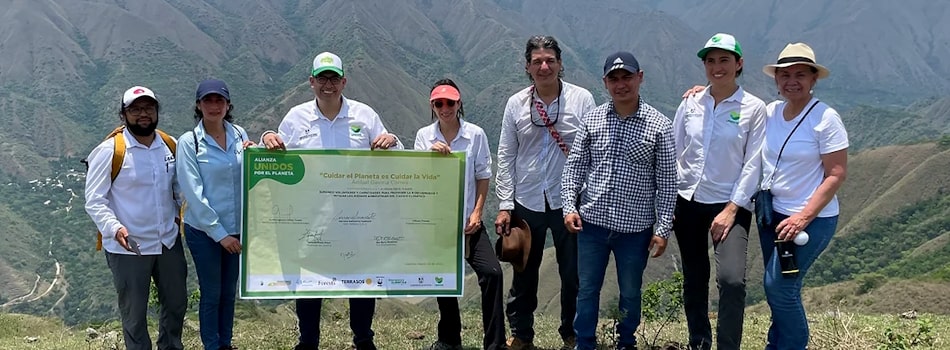
Terrasos becomes part of the Unidos por el Planeta Alliance to support Antioquia’s sustainable development efforts.
- Terrasos, a company with a focus on the structuring and operation of environmental investments, will be involved in the restoration and conservation of the tropical dry forest located in the municipality of Liborina.
- Unidos por el Planeta Alliance is an initiative spearheaded by the government of Antioquia and WWF Colombia. It brings together 81 public and private organizations with the shared objective of addressing the climate emergency in the department through concrete action.
Liborina, April 6, 2022
The United for the Planet Alliance has formalized the adhesion of Terrasos, the eighty-first organization to join this strategy, as part of its mission to protect biodiversity and mitigate the environmental effects of climate change. Terrasos joins the Alliance following the declaration of a Climate Emergency in the department, and will work with the Alliance and the Government of Antioquia and WWF Colombia to achieve these goals.
Terrasos, a company with a focus on the structuring and operation of environmental investments, has entered into an adhesion agreement with the Tropical Dry Forest Habitat Bank - Cauca River Canyon. This agreement concerns the restoration and conservation of the tropical dry forest in the municipality of Liborina.
"We are pleased to announce a new partnership that will enable us to develop effective strategies and initiatives to address climate change and advance our mission of making Antioquia a leading example of sustainable and regenerative territories," said Carlos Ignacio Uribe Tirado, Secretary of Environment and Sustainability.
This Habitat Bank, Tropical Dry Forest of the Cauca River Canyon, is aligned with the objectives of the United for the Planet Alliance, promoting compliance through preservation and restoration actions. These include tree planting, the recovery of degraded areas, and the protection of water resources. Additionally, the Bank seeks to advance sustainable rural development.
"Today we are joining the United for the Planet Alliance, with the Tropical Dry Forest Habitat Bank of the Cauca River Canyon, a strategic location for climate change adaptation. We will maximize the natural capital of the municipality of Liborina," says Mariana Sarmiento, CEO of Terrasos, an organization that currently has five habitat banks in the country.
Furthermore, as part of the adhesion celebration, Terrasos and ISA Intercolombia—a company that is also part of the United for the Planet Alliance—signed the acquisition of biodiversity credits to comply with a percentage of the biotic component compensation obligations associated with The "Antioquia - Medellín - Ancón Sur Connection and Associated 500/230 kilovolt Transmission Lines" electricity infrastructure project will promote the conservation of the tropical dry forest, one of the most threatened ecosystems in Colombia.
"ISA is committed to participating in and supporting biodiversity conservation initiatives in the various territories where we operate. One such initiative is the Habitat Bank, led by Terrasos, which aims to identify the most effective measures for protecting the tropical dry forest," states Luz Dary Perdomo, Coordinator of the Environmental and Social Projects Team of ISA Intercolombia.
It is important to highlight that Habitat Banks are lands where compensation requirements are incorporated and actions aimed at preserving, improving, or restoring ecosystems are undertaken to offset negative impacts on biodiversity.